LEANMARKETER JOURNAL
Choosing a Guest Posting Service: A Practical Buyer’s Guide
In this article
- Start with the reader and the destination
- Ask to see the publication before approving it
- Compare the complete offer
- Understand what the metrics can tell you
- Make approval meaningful
- Separate delivery promises from search promises
- Use a small first order to test the process
- Questions to resolve before a second order
The best guest posting service for your business is the one whose publications, editorial process and reporting fit a specific campaign. A large website count or an impressive authority score cannot answer that question alone. Before comparing providers, decide who should read your article, which page should receive interested visitors and what a useful result would look like. Those decisions turn a vague promise of “better SEO” into a service you can evaluate.
This guide is for buyers who want writing and placement support without losing control of their brand. It explains what to request before payment, how to compare apparently similar offers and how to run a small first order. It is a purchasing framework, rather than a ranked list built from unverified provider claims.
Start with the reader and the destination
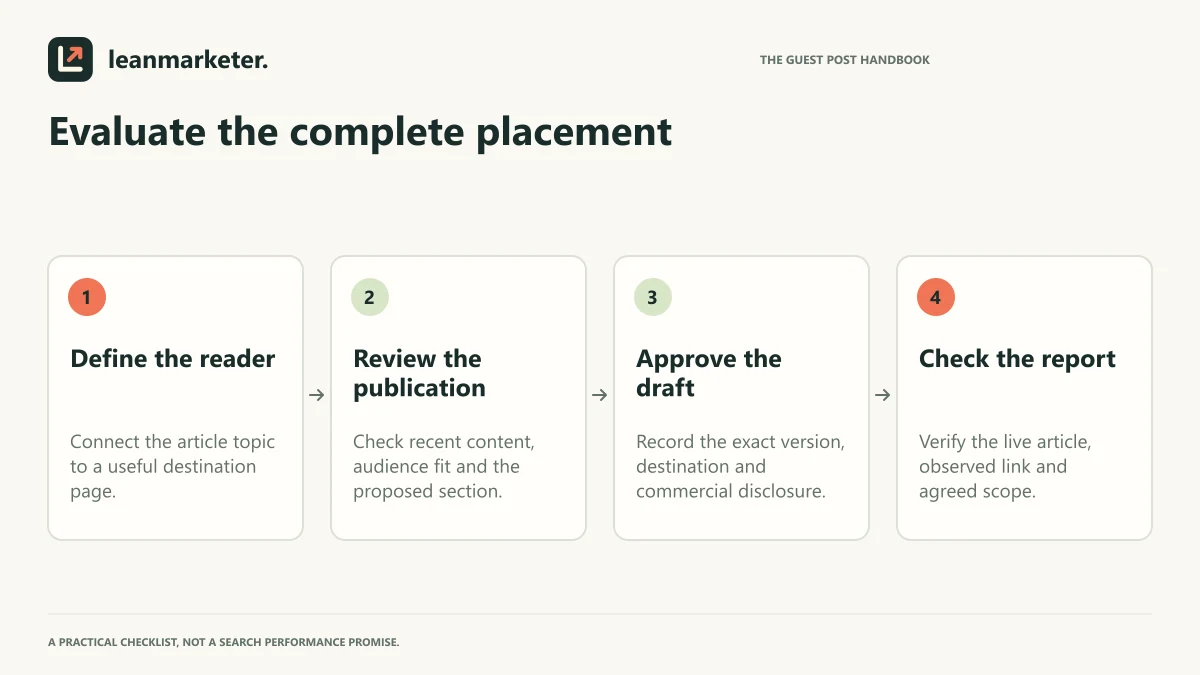
Write a brief that connects a reader problem to a useful destination. A project management company might contribute an article about handing work between agencies and clients, then reference its detailed handover checklist. A generic link to a pricing page would be a weaker fit if the article never discusses buying software. The publication, story and linked page should make sense together even when nobody mentions search rankings.
Choose one primary objective for the first order: relevant referral visits, credible coverage of a specialist topic, or a repeatable editorial process. Keep secondary search observations in the report, but do not let a short-term movement in a keyword substitute for evidence that the article reached an appropriate audience.
Ask to see the publication before approving it
A useful shortlist identifies the actual publication and explains why it belongs in your campaign. Read several recent articles, including examples outside the seller’s portfolio. Check whether the site covers a coherent subject, whether readers can navigate to articles naturally and whether commercial contributions are distinguishable from independent editorial work. A private catalog can make selection convenient; privacy itself does not establish quality.
Look at the proposed section as well as the domain. An otherwise relevant website may have a poorly maintained contributor area with little connection to its normal readership. Ask where the article will appear, who reviews it and whether it will remain accessible through ordinary navigation. Record the answers with the order so there is something concrete to check after delivery.
Compare the complete offer
| Buying question | Evidence to request | Reason it matters |
|---|---|---|
| Which publication am I approving? | Named website, relevant section and recent article examples. | You can assess the audience before committing. |
| Who writes and reviews the article? | Scope, revision process and named responsibilities. | Writing quality is part of the deliverable. |
| How is the commercial link treated? | Disclosure and expected link attributes. | You understand what is actually being purchased. |
| What happens after publication? | Report fields, monitoring scope and remedy terms. | A live URL is the beginning of verification, not the whole report. |
Compare providers against the same brief. One quote may include drafting and two revision rounds while another assumes you supply a finished article. A lower price can reflect owned inventory, a narrower scope or a different editorial model. A higher price can reflect additional work, but does not prove that work happened. Ask for an itemized explanation instead of treating either price point as a quality certificate.
Understand what the metrics can tell you
Domain Authority and Domain Rating summarize aspects of a provider’s own link data. They can help organize a shortlist, but they are not Google scores and do not establish the readership of a particular article. Traffic estimates also need a source, observation date and scope. Estimated organic visits to a whole domain are different from measured referral visits to your placement.
Ask how the seller handles missing or old measurements. “Unavailable” is a more useful answer than an invented number. Review trends alongside editorial quality, topic fit and the proposed location. An unusual metric should prompt a question, rather than an automatic conclusion that a website is either worthless or safe.
Make approval meaningful
Publication approval and article approval are separate decisions. Approving a website does not mean you have approved claims about your business, a particular anchor or a final draft. Ask for a process that records the version you reviewed and explains what happens if the publisher requests material changes afterwards. Someone should own the final check of names, product details and destination URLs.
The brief should also state which changes the writer can make without asking you. Correcting grammar is different from changing a technical claim or replacing a destination. A clear brief-to-report workflow reduces avoidable messages because both sides know when a decision is needed and which version is current.
Separate delivery promises from search promises
A service can define the article, approved publication, reporting and remedy it intends to provide. It cannot control Google’s indexing or ranking decisions. Google’s outbound-link guidance calls for appropriately qualifying paid placements, normally with sponsored or nofollow attributes. A seller’s willingness to explain that distinction is useful when comparing offers.
Read replacement terms carefully. What event qualifies, how long does the remedy period last, and does the remedy mean a correction, replacement placement or refund? A time-limited promise is different from a claim that every link will remain forever. Keep a copy of the terms attached to the order rather than relying on a sentence from a sales conversation.
Use a small first order to test the process
Start with a placement you can review thoroughly. Keep a record of the original brief, approved publication, article version, quoted scope and questions you asked. After delivery, check that the article loads, the intended destination is linked and the report accurately describes the attributes found. Review how the team handled revisions and uncertainty, not just how quickly it supplied a URL.
Imagine, for example, a buyer comparing two otherwise suitable offers. One team supplies a clear draft and catches an outdated product claim before approval. The other promises a higher authority score but cannot identify the publication until after payment. That is a process distinction the buyer can observe; it does not require inventing a predicted ranking uplift.
Questions to resolve before a second order
- Did the publication fit the intended reader and subject?
- Was the article useful without depending on its promotional reference?
- Were price, revisions, disclosure and remedies clear?
- Could you trace the delivered URL back to the version you approved?
- Did the report distinguish observed facts from estimates and promises?
Expand only when those answers justify it. A service that handles a small order clearly gives you evidence for planning the next one. Leanmarketer’s editorial standards and report overview show the questions its workspace is designed to surface. Review the current scope and terms before deciding whether the process fits your campaign.