LEANMARKETER JOURNAL
How to Vet Guest Post Websites: 15 Practical Checks
In this article
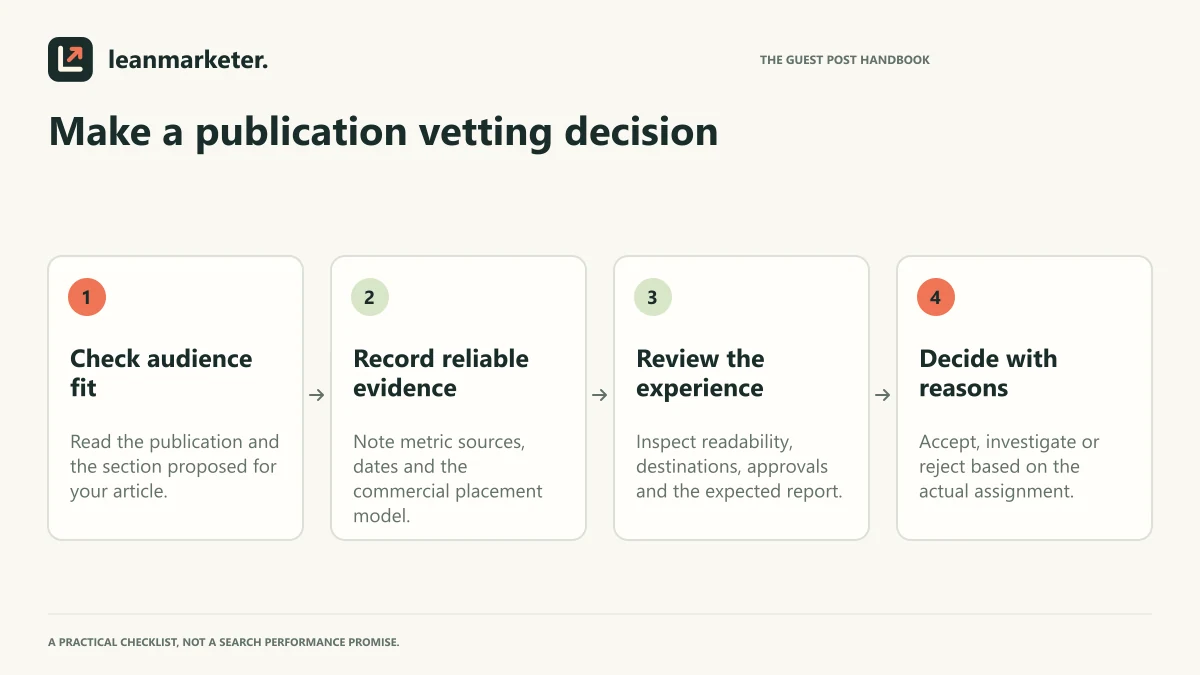
Vetting a guest post website means deciding whether a particular publication is suitable for a particular article. It is not a one-number test. Authority scores, traffic estimates and technical checks can help organize questions, but the proposed audience, section and editorial treatment still need review. Keep the decision tied to the reader you want to reach.
The following fifteen checks are designed for a practical shortlist. Record evidence, dates and uncertainty rather than forcing every item into an automatic pass or fail. A failed access check may need investigation; a clear audience mismatch may be enough to reject the placement immediately. The purpose is a reasoned decision, not an invented certificate of safety.
Audience and publication fit
1. Identify the normal reader
Read recent articles and describe who would use them. Do not rely solely on a publication’s category label. A business site aimed at founders may not serve the same questions as a specialist procurement journal, even when both discuss software.
2. Review the proposed section
Ask where the article will appear. A contributor area can differ from the publication’s main editorial work. Check whether the section has coherent coverage and can be found through ordinary navigation rather than only a direct URL.
3. Confirm topic relevance
Explain why your article belongs beside the existing coverage. The connection should be more specific than a shared broad keyword. If the only reason for choosing the site is its score, the editorial case is not yet complete.
4. Check geographic and language fit
Consider whether the intended readers can use the article and destination. A different country is not inherently a quality problem. The issue is whether language, market conditions and service availability match the question being answered.
5. Inspect recent editorial examples
Read several pieces rather than only the example supplied by a seller. Look for useful explanations, specific evidence and coherent structure. A new publication may have a small archive, so assess what is available without inventing a minimum article count.
Evidence and commercial context
6. Identify the placement model
Ask whether the contribution is independent, sponsored or on provider-owned inventory. Each can be described plainly. Ownership does not prove a site is unsuitable, but it should not be concealed behind a claim of unrelated media endorsement.
7. Record metric sources and dates
If DA, DR or estimated traffic is supplied, record its provider, observation date and domain scope. These measurements are not Google scores or verified readership of your article. Treat missing data as missing, rather than estimating a persuasive replacement.
8. Examine trends before a snapshot
A single traffic estimate cannot explain a publication’s history. Where historical data is available, compare like-for-like periods and ask about substantial changes. Do not diagnose a search penalty from one graph without checking alternative explanations and measurement limitations.
9. Review commercial disclosure
Read how sponsored articles and affiliate relationships are presented. Google’s outbound-link guidance explains paid-link qualification. Confirm the expected treatment for your order instead of discovering it only after publication.
10. Check authorship and factual care
Look for understandable authorship or editorial responsibility, supported material claims and a credible correction route. A social profile badge alone proves little. Equally, a team byline is not automatically deceptive when the publication explains how the content is produced and reviewed.
Reader experience and delivery
11. Open the site on mobile
Check whether articles are readable, navigation is usable and intrusive overlays prevent access to the text. Ordinary advertising does not automatically make a publication unsuitable. Assess the actual reader experience rather than treating one design preference as a ranking rule.
12. Check the intended destination
Make sure your own linked page supports the article’s promise and works for the intended audience. A suitable publication cannot compensate for a misleading or broken destination. Choose a durable reference when the article is meant to remain useful.
13. Confirm approval stages
Ask whether you can review the publication and exact article version, and how material publisher edits are handled. Keep those decisions separate. Approving a website is not permission to publish an unseen draft with unverified claims about your business.
14. Inspect the delivery report
Request fields that can be checked: article URL, destination, observed anchor, attributes and time. Ask how access failures are shown. A timeout or security challenge should not be silently labelled as either a confirmed live link or a deletion.
15. Read the remedy terms
Understand what happens when an agreed element is wrong or changes later. Clarify eligibility, response windows and replacement approval. A long advertised guarantee is not useful unless the provider explains the events and remedies it actually covers.
Turn the checks into a decision
Use three outcomes: suitable for the proposed article, needs clarification or unsuitable. Write a reason and identify any unresolved evidence. This is more useful than a total score that lets several weak points cancel out one decisive problem. An irrelevant audience may be enough to stop the assignment even when technical checks look fine.
For an illustrative shortlist, one publication may have modest metrics but a highly relevant professional readership and clear editorial standards. Another may show a larger score but offer an unrelated contributor section. The checklist does not claim which will improve rankings. It helps the buyer explain which better fits the article and why.
Keep the record current enough to use
Give a second reviewer the record without explaining the decision verbally. If they cannot understand the publication choice, the evidence or the open questions, improve the record before using it for a larger order. This is a useful test of whether the checklist captures judgment rather than merely collecting screenshots. It also helps when an agency hands work to a new account manager: the next person can see why the article belonged there and which conditions were important to the original approval.
Recheck important facts when a shortlist is used again after a long gap. Publications change owners, sections and commercial policies. A research record should show when it was last reviewed and which evidence was available. Do not copy an old “approved” label into a new campaign without checking whether the conditions still apply.
Leanmarketer’s quality overview and selection workflow provide a practical process to compare with these checks. Review the current scope and terms for any offer you consider. The strongest vetting record is one that preserves a clear reader-focused reason for the decision, including what remains uncertain.