LEANMARKETER JOURNAL
Anchor Text Optimization: Write Links That Explain the Destination
In this article
- Choose a destination before choosing words
- Use familiar anchor categories without quotas
- Write for the reader who scans
- Keep claims and references connected
- Give the editor a reason, not an instruction to manipulate
- Audit a portfolio without chasing cosmetic balance
- Check the final article, not only the draft
- A quick review exercise
Anchor text is the clickable wording of a link. Its first job is to tell a reader what they will find after clicking. Good optimization starts with that promise, then checks whether the destination delivers it. It does not start with a target percentage of branded, exact-match or generic phrases. There is no universal anchor distribution that makes a guest-post campaign safe or guarantees a ranking improvement.
A practical anchor review considers the article, the linked page and the relationship behind the placement together. The same wording can be helpful in one paragraph and misleading in another. Treat anchors as small editorial decisions that deserve a reason, rather than tokens to distribute until a spreadsheet turns green.
Choose a destination before choosing words
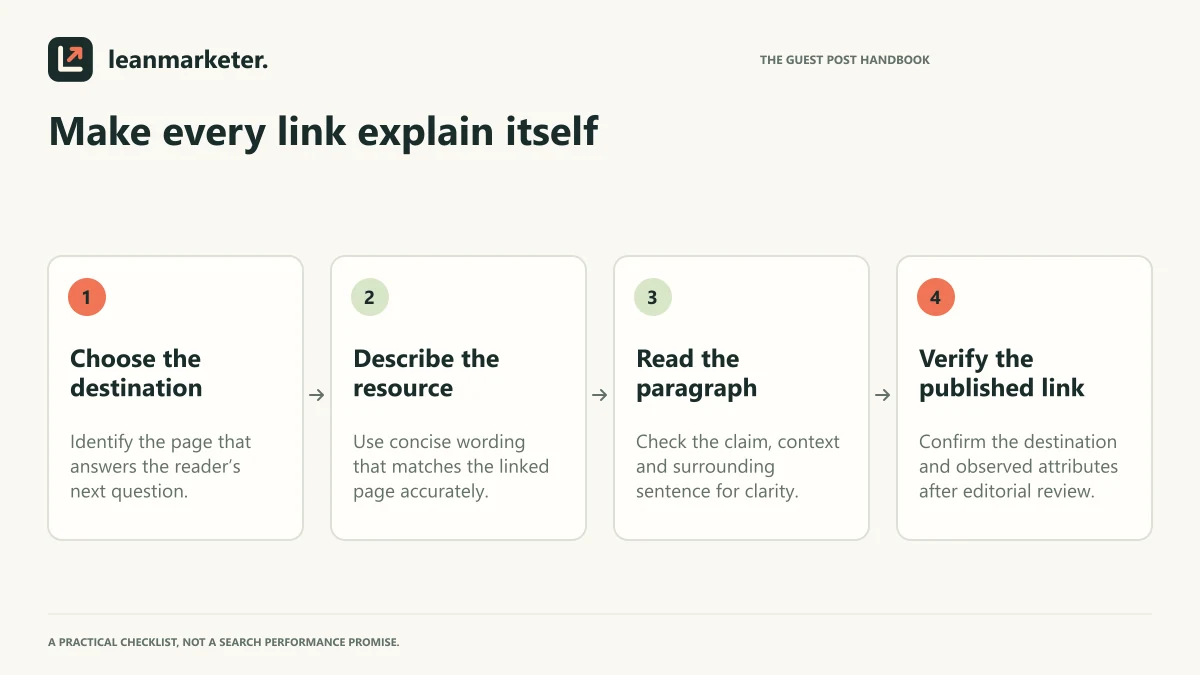
Imagine an article explaining how agencies hand projects to clients. If the reader needs a reusable checklist, link to the checklist itself. A homepage might explain the company, but require several additional clicks to reach the promised resource. A product pricing page answers a different question again. Choose the page that completes this particular thought before worrying about the phrase that contains the link.
Open the destination and identify its actual purpose. Is it a tutorial, a downloadable template, a product description or an opinion? Read beyond the heading. An anchor promising a free worksheet is inaccurate if the page contains only a sales enquiry form. If the destination has changed since the brief was written, revise the link proposal rather than preserving wording that no longer describes it.
Use familiar anchor categories without quotas
Branded anchors name the organization or product. Descriptive anchors explain a resource, such as “client handover checklist.” A partial-match phrase contains part of a target topic in natural wording. A naked URL shows the address itself. Generic phrases such as “read more” rely more heavily on their surrounding sentence. These are useful descriptions for an audit, not ingredients in a compulsory recipe.
The appropriate choice follows the sentence. A company introduction may naturally use the brand name. A technical explanation may need a precise resource title. Do not replace a clear description with an awkward brand phrase simply because a dashboard suggests your profile needs more branded anchors. Equally, do not insert the same commercial search phrase wherever a link appears, regardless of what the paragraph says.
Write for the reader who scans
Read the proposed anchor without the rest of the paragraph. It should usually provide a reasonable clue about the destination. Then read it inside the paragraph to check the relationship. A concise, descriptive phrase is easier to scan than a whole linked sentence containing several different claims. Avoid wording that implies an endorsement, certification or result the linked page does not establish.
Compare “click here” with “compare the article approval steps.” The second phrase helps a reader decide whether the next page is relevant. It also makes the action clearer when links are encountered out of their original visual arrangement. Google’s link best-practice guidance discusses descriptive anchor text and crawlable links; it does not supply a universal percentage allocation for your campaign.
Keep claims and references connected
A useful reference belongs close to the statement it supports. If the article claims a product performs a particular task, the destination should substantiate that task. If it points to an example, say what the example demonstrates. A link placed beside a dramatic claim does not automatically make the claim true. The writer still needs to check the evidence and explain any limits.
For a commercial placement, decide the disclosure and link attributes separately from the wording. An attractive anchor does not remove the commercial relationship. The publisher may need sponsored or nofollow qualification, and the final report should record what is actually present. Review the editorial standards and reporting questions before assuming that an anchor approval settles every aspect of a placement.
Give the editor a reason, not an instruction to manipulate
An effective brief names the destination, suggests wording and explains why the reader benefits. It can offer a second acceptable phrasing when the publication’s style requires a change. It should not demand that the editor hide a promotional reference inside unrelated copy. If the paragraph cannot accommodate the link honestly, choose a more suitable topic or destination instead of adding filler around it.
Record which elements are essential. The correct destination may be essential while exact wording is a preference. A product name may require an exact spelling while a descriptive phrase can vary. This distinction helps the editor improve the article without accidentally changing its meaning. The brief and article-review workflow shows where such decisions can be captured before a report is created.
Audit a portfolio without chasing cosmetic balance
Group existing links by destination and read representative examples. Look for misleading descriptions, forced repetition, broken URLs and articles whose topic has no plausible connection to the reference. These issues are more actionable than a percentage that differs from a competitor’s profile. Competitors have different brands, audiences and histories; their observed distribution is not your required target.
Keep a small record for each change: original wording, destination, reason for revision and whether the publisher accepted it. Prioritize links that confuse readers or point to obsolete pages. Do not send mass requests to rewrite otherwise helpful anchors merely to change a chart. The time is often better spent improving the linked resource so it answers the question its anchor promises.
Check the final article, not only the draft
After publication, open the article and follow the link. Confirm the destination, the observed wording and any qualification. Check whether editorial changes have altered the surrounding claim. A link can be technically present while its sentence now implies something inaccurate. Conversely, a sensible wording change may preserve the intended reader journey without using your original preferred phrase.
Keep that observation dated. Later changes should be assessed against the current article and destination, not assumed to be hostile or harmful. An anchor review succeeds when readers can understand and trust the connection. That is a concrete standard your writer, editor and client can discuss without pretending to know a private ranking formula.
A quick review exercise
Ask a colleague to read only the linked phrases in a draft and predict what each destination contains. Then open the pages together. Differences between those expectations and the actual resources reveal wording that needs attention before publication. This exercise also catches links whose surrounding paragraph is doing too much work to explain an otherwise vague label.