LEANMARKETER JOURNAL
Cold Email for Blogger Outreach: Build a Relevant Editorial Pitch

In this article
A useful outreach email gives an editor a quick way to judge a relevant idea. It explains who the article would help, what it would add and why the proposed contributor can write it credibly. There is no subject-line formula or universal reply rate that makes up for a weak fit. Start with the publication and its readers, rather than a large list of addresses.
Treat the message as a request for editorial consideration, not a demand for a link. The editor may decline, suggest a different topic or explain a commercial policy. Your process should accommodate those outcomes honestly. A campaign that counts only positive replies can hide unsuitable pitches, repeated follow-ups and unclear terms behind an attractive percentage.
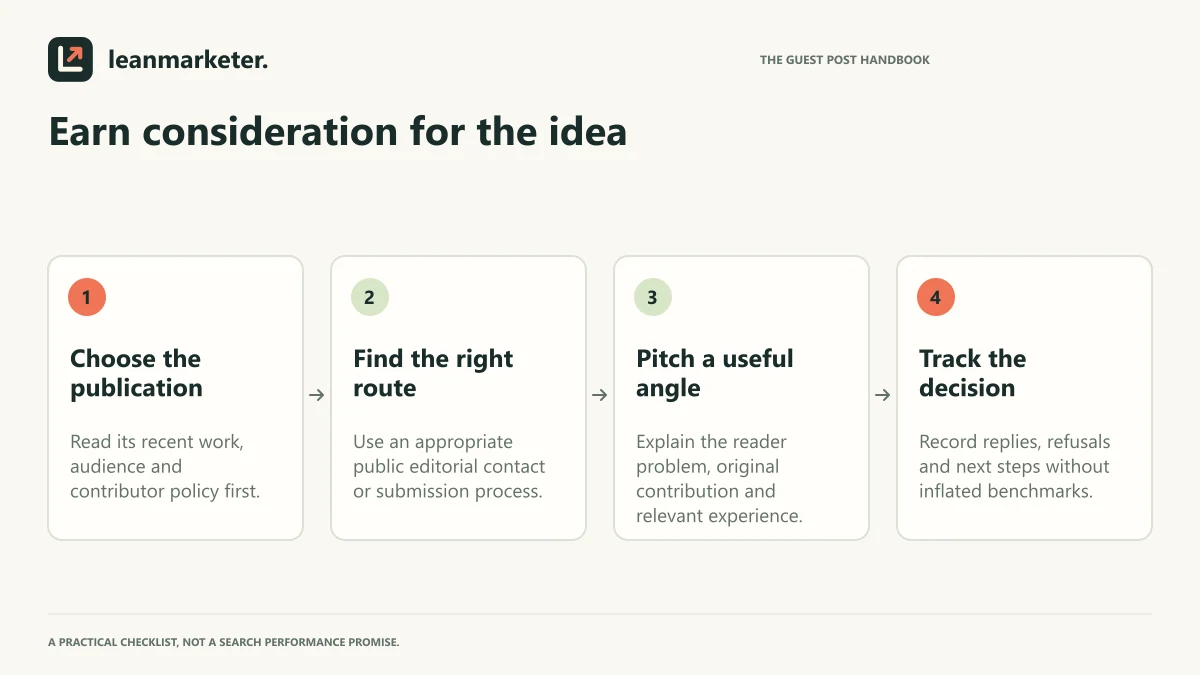
Read before you contact
Review recent articles, the publication’s categories and its contributor instructions. Identify the level of knowledge readers are expected to have and the kinds of examples the editor accepts. A broad match on a keyword is not enough. Two sites covering software may serve very different audiences: one may publish beginner tutorials while another addresses experienced engineering managers.
Write a short reason for including the publication in the shortlist. Name a specific reader question your contribution could answer. If the reason is only a metric threshold or an available email address, continue researching before drafting. The publication review questions offer a useful way to connect the proposed article with evidence of audience and editorial fit.
Use the public editorial route
Check for submission guidelines, a contributor form or a named editorial contact. Follow the requested process even if a personal address seems easier to find. An organization may use a shared inbox precisely so ideas can be routed and reviewed. Bypassing it does not necessarily improve the pitch and can create duplicate work if several colleagues contact different people at the same publication.
Keep contact records modest and relevant. Record the public source, the role and the date checked. Do not infer private contact details or treat a publicly visible name as permission for repeated commercial messages. Consider the applicable rules and the recipient’s stated preferences before sending. A legitimate editorial proposal should be easy to identify, decline and stop receiving.
Write a subject line that names the idea
A clear subject can state the proposed topic or format, such as a practical guide to a particular reader problem. Avoid pretending to continue an earlier conversation or implying a relationship that does not exist. “Following up on our discussion” is misleading when there was no discussion. An honest subject helps the editor triage the message and sets the tone for the rest of the exchange.
Do not promise an outcome the article cannot establish. A subject claiming a guaranteed traffic increase may attract attention while undermining the proposal’s credibility. Use the concrete angle instead: a checklist, a worked example, an explanation of a difficult decision or a transparent analysis of original data. The idea should remain worthwhile after the promotional language is removed.
Make the body easy to evaluate
In a few short paragraphs, introduce yourself accurately, explain the fit and summarize the proposed contribution. Mention the evidence or experience you can provide. Offer a brief outline if it helps clarify the idea. Keep links selective so the editor can find a relevant writing sample without navigating a large portfolio or opening several attachments from an unfamiliar sender.
For an illustrative pitch, a practitioner might propose an article explaining how small agencies decide who approves a project handoff. The outline could distinguish client, project manager and specialist review responsibilities, with a sample checklist. That is more informative than “I can write a high-quality SEO article on any topic.” It gives the editor something specific to accept, reshape or decline.
Be clear about commercial conditions
If the request involves a paid placement, a company reference or another material condition, do not wait until the editor has invested in the idea to reveal it. Ask how the publication handles the arrangement and its link policy. A useful article does not turn a commercial reference into independent coverage. Keep the terms visible to the person approving the campaign.
The brief and approval process illustrates where destination and article decisions can be recorded. Do not demand a fixed commercial anchor if the publication’s policy does not support it. A rejected condition may mean the publication is unsuitable for this order, even when its audience otherwise appears relevant.
Protect technical sending basics
Use a recognizable sender identity and maintain the configuration of the mail system you use. Google’s sender guidelines are one primary reference for mail sent to personal Gmail accounts. Authentication and provider requirements are important, but passing technical checks does not make every unsolicited message welcome or guarantee inbox placement.
Do not use account rotation or artificial conversations as a substitute for relevant outreach. If messages bounce or recipients object, investigate the cause before expanding the campaign. Check the list, message and sending setup. A technical delivery problem and an editorial rejection are different events, and they should receive different responses rather than being combined into a single poor reply-rate diagnosis.
Follow up with a reason and a stopping rule
Allow time for the publication’s process. A brief reminder may be reasonable when the proposal remains relevant and the recipient has not declined. Add useful context if something has changed, rather than repeating the same request under increasingly urgent subjects. Stop when asked, and do not move the conversation to another colleague merely to evade a refusal or a stated preference.
Track outcomes with clear definitions: delivered where known, replied, declined, revised, commissioned and published. Keep small sample sizes and differences in publication fit visible. The learning is which ideas and processes produce useful editorial conversations. It is not a promise that a particular template will make every campaign reach a fixed percentage of replies or placements.
Review one complete conversation before scaling
Choose a representative thread and ask a colleague to reconstruct why the publication was selected, what the idea promised and how the response was handled. If they cannot do that from the record, improve the handoff before adding more recipients. This exercise can reveal missing context that a reply-rate dashboard never shows. It also gives a new team member a practical example of relevant outreach, including how a respectful refusal is recorded and why another reminder is or is not appropriate.