LEANMARKETER JOURNAL
B2B SaaS Link Building: Turn Product Knowledge into Useful Editorial Assets
In this article
- Choose a decision your buyer actually makes
- Build an asset that remains useful without a product pitch
- Separate demonstrations from research
- Match the publication to the asset
- Write a pitch around the contribution
- Choose a destination that completes the explanation
- Review the published article as a technical document
- Try the asset before pitching it
- Evaluate the work beyond a backlink count
A useful B2B SaaS link-building campaign starts with knowledge a technical or commercial buyer can use. Your product team may understand implementation failures, migration trade-offs or procurement questions better than a general business writer. Turn that knowledge into an editorial asset before looking for a publication. A genuinely helpful example gives an editor a reason to consider the article beyond the fact that your company wants a link.
This playbook focuses on creating and pitching those assets. Choosing a service provider is a separate purchasing decision. Here the work is deciding what your team can contribute, proving it clearly and matching the contribution to a publication whose readers face the same problem.
Choose a decision your buyer actually makes
“The future of SaaS” is a large subject with little reason to choose your contribution. “How a small operations team can document approval ownership before changing workflow tools” is narrower and easier to support. Start with questions from onboarding calls, support tickets and sales objections. Remove customer details and identify the decision underneath the question.
Distinguish the user from the buyer. A developer may need a reproducible integration example, while a procurement lead needs to compare ownership and support requirements. Both can be valuable subjects, but an article that switches between them without explanation often satisfies neither. Name one primary reader in the brief and let that choice guide the depth of the article.
Build an asset that remains useful without a product pitch
Strong SaaS contributions often take the form of a diagnostic checklist, annotated workflow, migration comparison or small reproducible test. The reader should understand the problem and apply the method even if they never purchase your product. That independence makes the article easier to adapt to a publisher’s editorial standards.
| Buyer question | Potential asset | Evidence to prepare |
|---|---|---|
| Who owns the handoff? | An approval-responsibility map. | A worked example with clearly identified roles. |
| What changes during migration? | A before-and-after workflow. | Documented assumptions and failure conditions. |
| How should we compare options? | A decision worksheet. | Criteria that can be applied to multiple suppliers. |
| Can an integration be reproduced? | A technical walkthrough. | Current documentation and a tested example. |
A comparison worksheet should not quietly award your product points for requirements that only your product defines. Explain the criteria, acknowledge trade-offs and show when a different approach fits. If an example relies on a paid feature, particular data volume or administrator access, state that condition near the relevant step rather than hiding it in a footnote.
Separate demonstrations from research
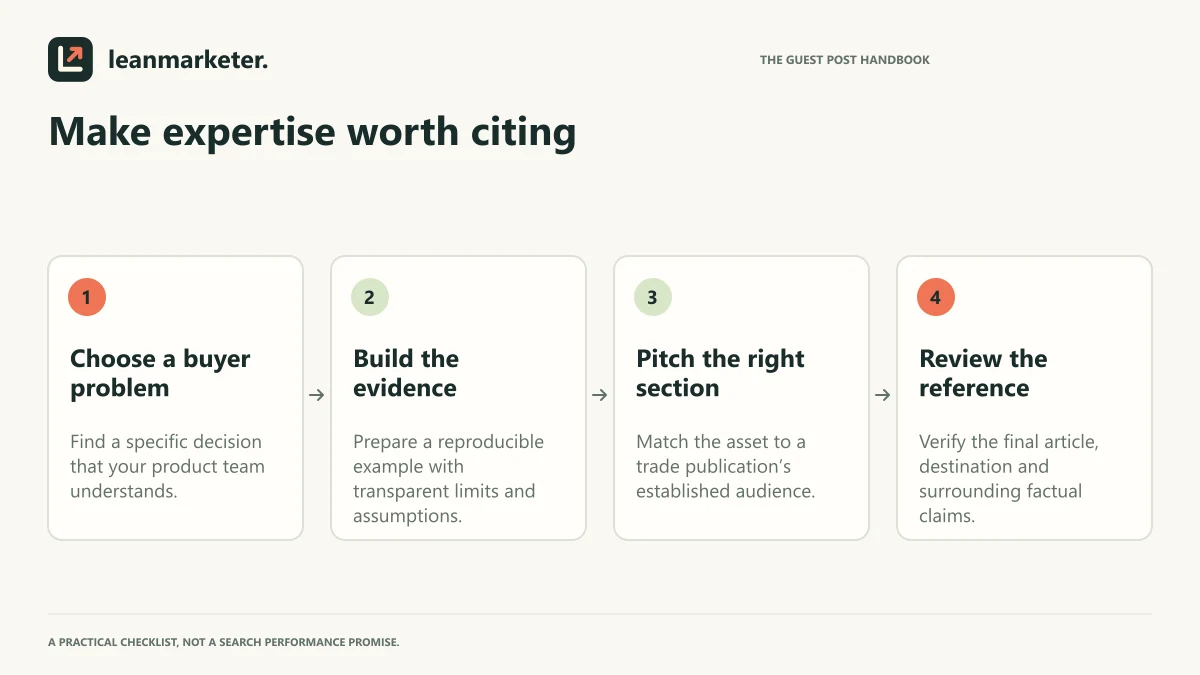
A test performed by your team can illustrate a workflow, but it is not automatically representative of all customers. Record the setup, sample, date and limitations. Do not turn a single successful implementation into a claim that every business will save the same amount of time. If a number cannot be traced to an approved source, leave it out.
Customer evidence needs additional care. Obtain permission for named examples, confirm who can approve quotations and remove identifying details from screenshots. An anonymized example can still reveal a customer through a distinctive configuration. When real data is unnecessary, use an explicitly illustrative scenario with sensible assumptions and no invented success statistics.
Match the publication to the asset
Read the section you intend to pitch. A developer publication may welcome implementation details that would overwhelm a business operations audience. A trade publication may prefer a practical decision framework backed by an experienced practitioner. Look at recent articles, their assumed knowledge and the kinds of sources they use before preparing a subject line.
Build a shortlist around audience overlap rather than collecting every site that mentions software. Record the proposed section, the reader problem and one relevant example from its archive. A publication’s authority score can be an organizing field, but cannot establish whether this particular asset belongs there. Make the case from the reader’s task.
Write a pitch around the contribution
A concise pitch can explain the question, the unusual evidence and the intended takeaway. For example: “Your recent article covered workflow selection. Our implementation team has a practical method for mapping approval ownership before migration. We can contribute an annotated example showing where responsibility is often left undefined.” This is an illustrative pitch structure, not a claim of an existing editorial relationship.
Include the proposed author’s actual role and why that person can answer follow-up questions. Avoid invented expert personas or biographies assembled only for outreach. Offer a short outline and disclose any commercial relationship. Do not make acceptance conditional on a prescribed promotional anchor or demand that an editor use your preferred sales language.
Choose a destination that completes the explanation
The linked resource might be a full worksheet, a documented methodology or a deeper technical explanation. A product page can be relevant when the article genuinely discusses that product, but it should not be substituted for the resource promised by the surrounding sentence. Check that a reader arriving without context can understand the page.
Use the same care with internal links on your own site. The destination should offer an obvious next step, current information and a clear distinction between education and sales. Leanmarketer’s guide to useful landing-page structure offers a way to review that handoff before promoting the resource.
Review the published article as a technical document
Check code, screenshots, product descriptions and dates after publication. Editorial changes can accidentally remove a qualification or make a narrow example sound universal. Confirm that the destination and observed link attributes match the arrangement, and document any requested correction. An article being reachable does not prove that every technical statement remains current.
Google’s helpful-content guidance emphasizes reader value and credible information. Treat that as a useful editorial direction, rather than a formula promising a particular ranking. Keep the asset maintained as the product and the reader’s needs change.
Try the asset before pitching it
Ask a colleague who did not create the worksheet to use it on a fresh example. Note where they need an explanation, which assumptions they miss and whether the output helps their decision. Revise those points before presenting the resource as ready for an external audience.
Evaluate the work beyond a backlink count
Record whether the contribution reached a relevant publication, whether the asset was used as intended and whether the process produced useful questions from readers. Review qualified referral visits and enquiries when you have reliable measurement. Keep those observations separate from general changes in search performance, which may have several causes.
If you are considering support for the writing and placement workflow, review Leanmarketer’s editorial and reporting standards. Review current scope, availability and terms before commissioning the contribution. A small, well-briefed example is a more useful starting point than a promise to dominate software keywords through a fixed number of placements.