LEANMARKETER JOURNAL
Guest Post Pricing: Compare the Complete Cost
In this article
Guest post pricing makes sense only when you know what the fee includes. You may be paying for writing, editorial review, access to a publication, project management and verification, or for just one part of that process. Comparing “price per link” without comparing scope can make a cheap offer look expensive after revisions, or make a large quote seem better than its evidence supports.
There is no universal price that proves a guest post is legitimate. Owned publications, independent editorial pitches and fully managed campaigns have different costs. A sensible budget starts with the reader you want to reach, a relevant article and a clear deliverable. This guide shows how to compare quotes, estimate your own total cost and avoid buying an impressive number instead of useful work.
What the fee should describe
Separate writing from placement. Writing may include research, an outline, interviews, fact checking and revisions. Placement may involve reviewing an existing publication list, contacting an independent editor or coordinating an article on a provider’s own site. These activities are not interchangeable. Ask which will actually happen for your order, and whether you can review the publication and draft before delivery.
Project work also has a cost. Someone must collect your brief, resolve questions, maintain the approved version and check the final URL. If a quote includes reporting or monitoring, ask what is measured and how often. Checking whether a destination link exists is different from measuring referral traffic or proving that Google has indexed a page.
Compare quotes line by line
| Cost component | Question to ask | Possible difference between offers |
|---|---|---|
| Article production | Is writing included, and what research does it cover? | Supplied article versus a researched original draft. |
| Editorial review | Which revisions are included? | Corrections only versus substantive changes before approval. |
| Publication | Which website and section am I approving? | Named owned inventory versus an independent pitch. |
| Delivery report | What evidence will I receive? | A URL alone versus documented destination and link attributes. |
| Aftercare | What happens if the article changes? | No follow-up versus a defined check and remedy process. |
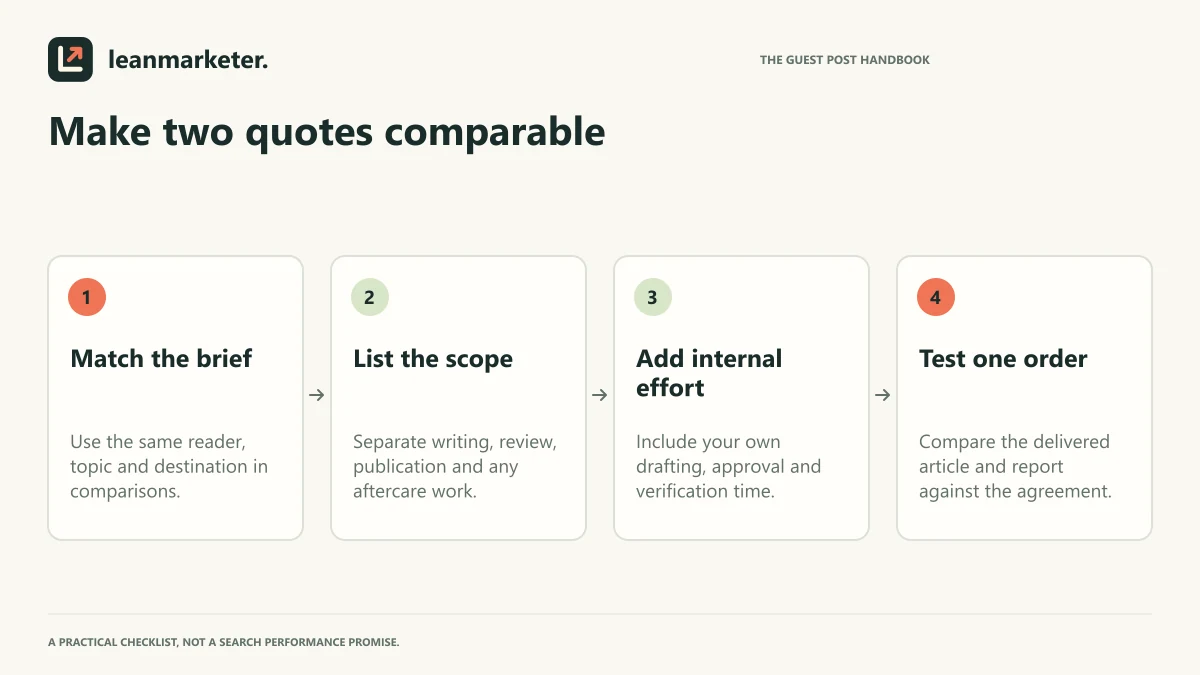
Use the same article brief when requesting comparisons. A specialist technical article that requires an expert review is a different assignment from a straightforward introduction to a familiar business topic. If a provider needs to change the scope, it should explain the change before you agree. An unexplained bundle of extra services is difficult to compare and difficult to verify afterwards.
Why authority-based price bands need context
Some catalogs organize prices around DA, DR or estimated traffic. Those fields can make browsing quicker, but they are third-party observations rather than a direct price list for search outcomes. The publication’s topical fit, editorial attention and actual placement location still matter. Ask for the metric provider, measurement date and whether the traffic figure covers the whole domain or a particular page.
Do not assume that a low-priced article comes from a network or that a costly one reaches your intended buyers. Read the publication. Look for evidence that its normal content serves a recognizable audience. The cost of reviewing a shortlist is small compared with repeating an unsuitable placement across a campaign because a score looked attractive.
Calculate the full cost of an order
Consider an illustrative comparison, rather than a market benchmark. An offer costs $75 and includes writing. Your team spends one hour reviewing it. If that hour is valued internally at $40, the planning cost is $115 before any applicable taxes or additional work. A second offer costs $50 but requires an article that takes your team three hours to prepare. Using the same internal rate, its planning cost is $170. The lower listed fee is not the lower total in this example.
That calculation does not prove either placement will perform better. It simply prevents the writing and review work from disappearing from the comparison. Add only costs relevant to your situation, and state the assumptions. If your team already has suitable original material, supplied-content pricing may make sense. If it needs specialist support, compare the quality and scope of that support directly.
Keep delivery and outcomes in separate columns
A purchased deliverable can have an agreed acceptance check: the article appears on the approved publication, the correct page is referenced and the report describes what was observed. Referral visits, leads and search visibility belong in a separate performance review. They can inform the next decision, but should not be presented as automatic consequences of a fee.
Paid placements also need appropriate treatment. Google’s guidance for qualifying outbound links describes sponsored and nofollow attributes for commercial relationships. Paying more for an unqualified link does not turn it into independent editorial coverage. Ask how disclosure and attributes will be handled before judging a quote against your objectives.
Read the exclusions
Find out whether the price includes image sourcing, expert interviews, extensive rewriting or a second destination. Ask what happens when a publisher rejects the draft or changes its policy. If a replacement is offered, clarify what makes a replacement comparable and how you approve it. “Support included” is not a substitute for explaining the events that support covers.
Delivery timing also deserves a specific definition. The clock may begin after payment, after you submit a complete brief or after you approve an outline. Customer feedback and additional research can change the timeline. Ask for milestones rather than treating every delay as the same problem. This makes the price easier to assess because you know which work is still outstanding.
How to use a small starting budget
Choose a first order you can evaluate carefully. Do not spend the whole budget on a large bundle merely to reach a lower unit price. Keep enough time for publication review, article feedback and delivery verification. Record what you learned about relevance, writing quality and the provider’s communication before increasing the quantity.
Leanmarketer’s pricing overview is a concrete scope to compare with your own brief. Review what the current offer includes for writing, supplied articles, review and reporting. Use the workflow overview to follow the handoffs, and record any additional requirements in your quote. Published price bands should help you begin that comparison, rather than replace an agreement about the specific work you need.
A decision you can explain
The useful question is not “How little can I pay for a backlink?” It is “What article, publication, review and evidence will this budget buy?” A clear answer gives your team something to approve and your provider something to deliver. Start with that agreement, keep assumptions visible and use observed results to decide whether the next order deserves a larger budget.