LEANMARKETER JOURNAL
DR vs. DA: Use Authority Metrics Without Confusing Their Meaning
In this article
- Understand the intended measurement
- Compare like with like
- Keep domain and page metrics separate
- Do not turn a catalog filter into a quality certificate
- Investigate large disagreements
- Use traffic and editorial evidence alongside scores
- An illustrative shortlist decision
- Ask for honest missing-data handling
Domain Rating and Domain Authority are different companies’ measurements, not two names for a Google score. Ahrefs produces DR; Moz produces DA. They can help compare aspects of websites within their respective datasets, but neither tells you that a particular guest article will reach your audience or improve your rankings. Use them as context for investigation rather than a purchasing verdict.
When choosing publications, the better question is what the metric measures, how recently it was observed and what it leaves out. A difference between DA and DR can be unsurprising because the tools use different data and methods. Averaging the two numbers does not create a more accurate universal authority score.
Understand the intended measurement
Ahrefs describes Domain Rating as a relative measure of a website’s backlink profile in its database. Its interpretation depends on the tool’s link data and calculation, not only a simple count of links. A higher number should not be read as a promise about the readership of an individual article.
Moz describes DA as its own predictive domain-level metric. Its Domain Authority guide explains the important distinction that DA is not a Google ranking factor. That historical guide is useful for the metric’s purpose, not as a claim that every detail of the calculation remains unchanged.
Compare like with like
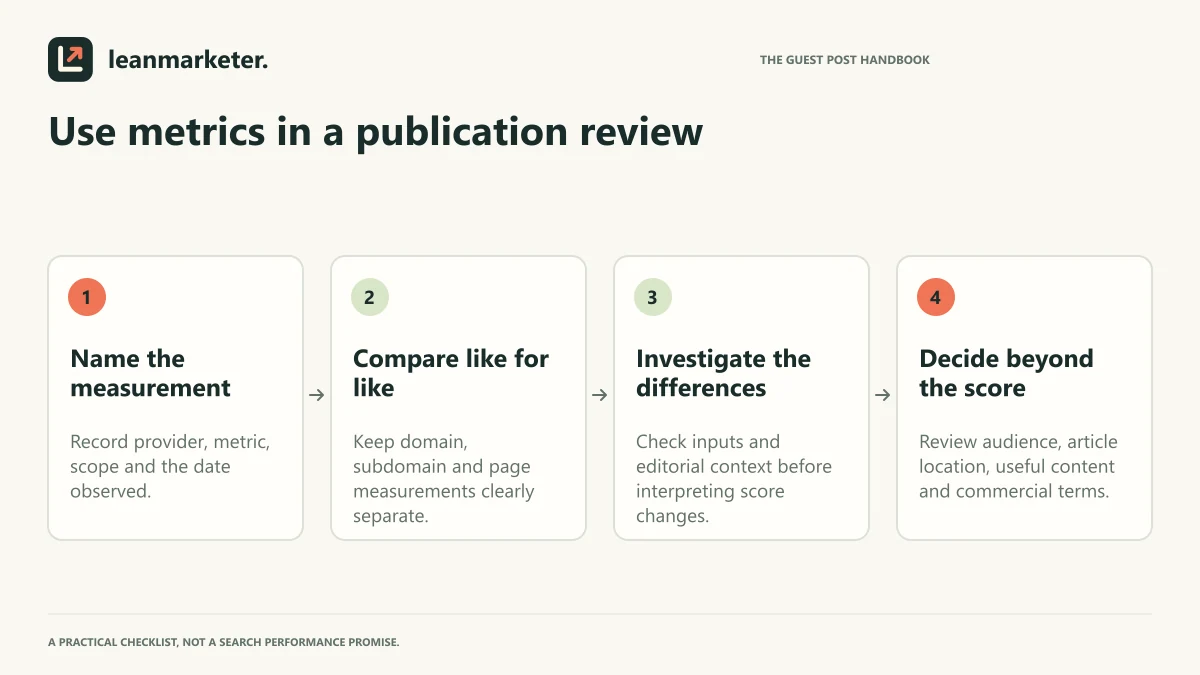
Record the tool, metric name, observation date and scope. A root domain, a subdomain and a specific page can be different objects in a tool. A seller’s screenshot is difficult to interpret when the input is hidden or the observation is old. Ask for the exact domain and avoid comparing a current result with an unidentified historical export.
Use the same metric and scope when organizing a shortlist. If a tool changes its methodology, preserve the version or context when it is available. A score can move because the underlying website changed, the wider dataset changed or the measurement method changed. Do not assume every movement proves a corresponding change in Google’s assessment.
Keep domain and page metrics separate
| Measurement | Scope | Important limitation |
|---|---|---|
| DA | Moz domain-level metric. | Not a Google score or article readership measurement. |
| DR | Ahrefs domain-level link metric. | Depends on Ahrefs data and relative calculation. |
| PA or UR | Provider-specific page or URL metric. | Different metrics should not be relabelled as each other. |
| Estimated organic traffic | Tool estimate with a defined scope. | Not the same as verified analytics or total visits. |
A strong domain-level score does not establish that a new contributor article will be well integrated into the publication. Review the proposed section and normal navigation. Likewise, a page-level score observed before a redesign may not describe the article location currently being offered. The placement context remains a separate decision.
Do not turn a catalog filter into a quality certificate
A minimum score can reduce the number of sites a team reviews, but it also excludes sites for reasons unrelated to reader fit. A specialist publication with modest measured link strength may still have useful expertise and a relevant professional audience. A broad high-scoring site may have a contributor area that does not serve your subject well.
If your procurement process uses a threshold, describe it honestly as an internal selection rule. Do not call it Google’s requirement or a proven boundary between safe and harmful links. Write the reason for any exception and retain the editorial evidence. That creates a more useful decision record than pretending the filter answers every quality question.
Investigate large disagreements
If DA and DR differ substantially, first check the inputs and dates. Are both results for the same domain? Is one a cached result? Does the publication use an important subdomain or recently moved content? These ordinary explanations should be considered before accusing the site of manipulating a score.
Then inspect the publication itself. Read recent work, examine relevant sections and consider whether the proposed destination belongs in the article. A metric disagreement can be a reason for additional questions, but it is not evidence that every other signal should be ignored. You are choosing a communication opportunity, not resolving a contest between tool brands.
Use traffic and editorial evidence alongside scores
When traffic estimates are available, label them with the provider, scope and date. Look at relevant topics and geography rather than only a whole-domain total. A site can attract visits to unrelated content. A low estimate may also reflect a tool’s limited coverage of a niche or market. Neither number should be relabelled as verified human readership.
Read the content for original explanation, factual care and a coherent reader purpose. Ask about disclosure and the placement model. A private catalog, owned site or independent publisher can all be evaluated transparently. None becomes suitable solely because one metric looks impressive.
An illustrative shortlist decision
Imagine two publications proposed for an article about a specialist business workflow. One has higher measured domain scores but mostly covers general consumer topics. The other has lower scores, a dedicated professional section and recent articles addressing the same reader’s problems. The second may be the more coherent editorial choice, even though no one can predict its ranking effect.
Record that reasoning explicitly: audience fit, section quality, useful reference and commercial terms. If the team chooses the first publication instead, it should explain a different reader benefit rather than simply pointing to its larger number. The example is a decision exercise, not a claim that lower scores always outperform higher ones.
Ask for honest missing-data handling
Should a buyer pay more simply because one score is higher? Only if the complete offer justifies the price for the campaign. A metric difference does not tell you how much research, writing or editorial attention is included. Compare those tasks and the actual publication location before deciding. Keep the score in its own field instead of allowing it to silently stand for every aspect of quality, audience fit and expected commercial value.
A missing PA value is not the same as zero, and Ahrefs UR should not be substituted under a Moz PA label. If a provider cannot obtain a metric, the catalog should show that it is unavailable. A genuine zero observation should also remain visible rather than disappear because it looks less persuasive.
Leanmarketer’s quality overview and selection workflow are useful places to inspect how evidence supports publication choice. Check current sources and dates where metrics are provided. Use DA and DR to organize questions, then make the placement decision with the article, publication and reader in view.