LEANMARKETER JOURNAL
Exact-Match Anchor Text: When Precision Becomes Forced Repetition
In this article
- A precise description can be useful
- Evaluate the arrangement behind the wording
- What forced repetition looks like in practice
- Review destinations before requesting changes
- Give writers flexible, truthful instructions
- Avoid cosmetic anchor-cleanup campaigns
- What to put in the approval record
- A better standard than a percentage
An exact-match anchor uses the same wording as a search phrase someone hopes to rank for. That can be a perfectly ordinary description: an article about invoice templates may naturally reference an “invoice template.” The concern is the surrounding arrangement and pattern, especially when commercial wording is forced into unrelated contributions or purchased links are presented as independent recommendations.
You cannot judge a link from its anchor category alone. Nor can you calculate a universally safe exact-match percentage and assume everything below it is acceptable. Review why the link exists, what the sentence promises and how the publisher treats the commercial relationship. Those questions produce decisions you can explain without inventing an algorithmic threshold.
A precise description can be useful
If a destination is a guide to accessibility testing, those words may describe it more accurately than a vague brand name. The phrase is useful because it helps the reader identify the resource. Its similarity to a search query does not by itself prove manipulation. A sensible editor can retain clear wording while still checking whether the reference belongs in the article.
Problems begin when the phrase overrides the sentence. A local business might insist on a long “best emergency service city” anchor in an article that never discusses that service or location. The wording sounds unnatural because it serves the buying instruction rather than the reader. Replacing the phrase alone may not repair the mismatch; the proposed destination or article topic may also need to change.
Evaluate the arrangement behind the wording
Ask whether the publication chose the reference for its informational contribution or whether a buyer is purchasing a ranking-oriented link. Google’s link-spam policies address manipulative link arrangements. A polished paragraph and a high authority score do not turn such an arrangement into independent editorial coverage. Commercial links need appropriate treatment even when the text reads smoothly.
This distinction matters when reviewing old campaigns. A spreadsheet showing repeated phrases can be a starting point, but it does not explain how those links were acquired. Retain invoices, briefs and publisher correspondence where available. Review a manageable sample of real pages. The investigation should establish what happened, rather than classify every precise phrase as evidence of a penalty.
What forced repetition looks like in practice
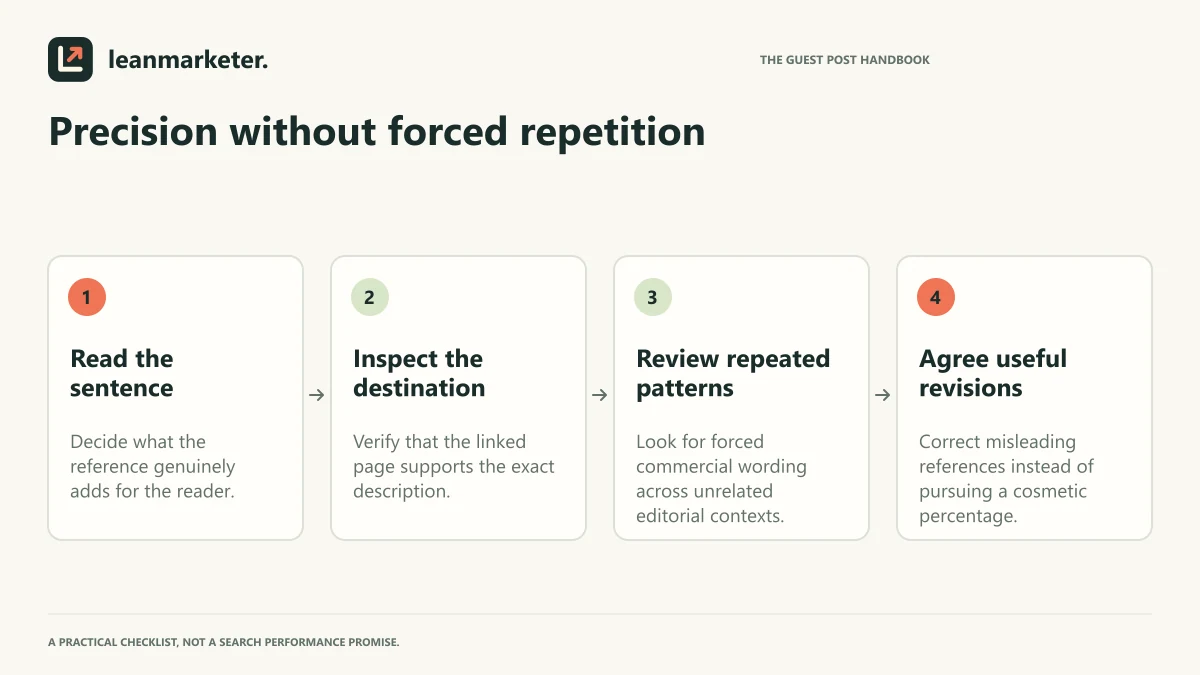
Look for a phrase repeated across articles whose audiences and subjects differ substantially. Check whether the same sales claim appears beside it, whether the destination answers the article’s question and whether the reference would make sense without a commercial instruction. Identical wording may be an appropriate resource title, so read the examples before deciding that repetition alone is the problem.
Another warning is a draft constructed around the anchor instead of the topic. The introduction promises one question, the middle detours into a promotional paragraph and the conclusion returns to the original subject. The article may reach a requested word count, yet the reader journey is broken. A stronger revision removes the detour and rebuilds the piece around a useful, consistent purpose.
Review destinations before requesting changes
A service page, comparison guide and research report deserve different descriptions. Open each destination and note what a visitor can actually do there. A phrase such as “research findings” is misleading when the page contains no published method or results. A phrase such as “pricing options” is more honest when the destination primarily describes packages and costs.
The destination can also become outdated. A once-useful guide might have moved, changed scope or been replaced by a product page. Before asking a publisher to alter the anchor, decide whether you need a different URL. The placement review questions help separate content accuracy from the narrower task of checking whether an HTML link exists.
Give writers flexible, truthful instructions
Provide a preferred anchor together with its purpose. Explain the resource and identify wording that must remain exact, such as a product name or technical standard. Allow the writer to adapt ordinary descriptive language to the publisher’s style. This produces a more useful brief than a demand to insert a fixed commercial phrase a specified number of times.
For an illustrative example, a software company could request a reference to its onboarding checklist. “A downloadable onboarding checklist” and “the team’s onboarding checklist” may both be accurate. The editor can choose the phrasing that fits. The company should object if the sentence claims the checklist guarantees compliance or if the link leads somewhere unrelated, rather than treating every wording variation as a failure.
Avoid cosmetic anchor-cleanup campaigns
Do not replace clear phrases with random generic text merely to make a distribution chart look more varied. “Click here” can make the article harder to understand while leaving the original commercial arrangement unchanged. Adding more links to dilute a percentage can create additional low-value work without repairing the underlying issue. Focus on misleading descriptions, unsuitable destinations and arrangements that need correction.
If Search Console reports a manual action, use the specific official process for that action. A traffic decline or an unfamiliar anchor is not enough to diagnose one. Keep ordinary editorial improvement separate from a formal remediation project. This prevents a routine content audit from becoming a series of speculative requests to remove useful references across the web.
What to put in the approval record
Keep the proposed destination, the wording approved in the draft and the explanation for the reference. Note whether wording is essential or flexible, who reviewed factual claims and how a commercial placement should be qualified. A versioned article approval process makes those decisions easier to trace when the final article differs from an early draft.
After delivery, read the published sentence and follow the link. Record the actual anchor, destination and attributes rather than copying the preferred anchor from the brief into the report. If a correction is needed, describe the reader problem precisely. “This link promises a tutorial but opens a sales form” gives an editor a better reason to act than “our exact-match percentage is too high.”
A better standard than a percentage
Use precise anchor text when it accurately describes a relevant resource. Reject wording that distorts the article, conceals a commercial arrangement or promises something the destination cannot supply. The practical goal is a credible reference inside a useful contribution. You can evaluate that standard consistently while acknowledging that no anchor formula guarantees a particular search outcome.
When several reviewers disagree, ask each person to describe the reader’s next task. That usually exposes whether the debate concerns wording, destination or the article’s purpose. Resolve that underlying decision before approving another draft. A more polished phrase cannot repair a reference whose purpose the team has never agreed.