LEANMARKETER JOURNAL
Seven Guest-Post Pitch Templates You Can Adapt Honestly
In this article
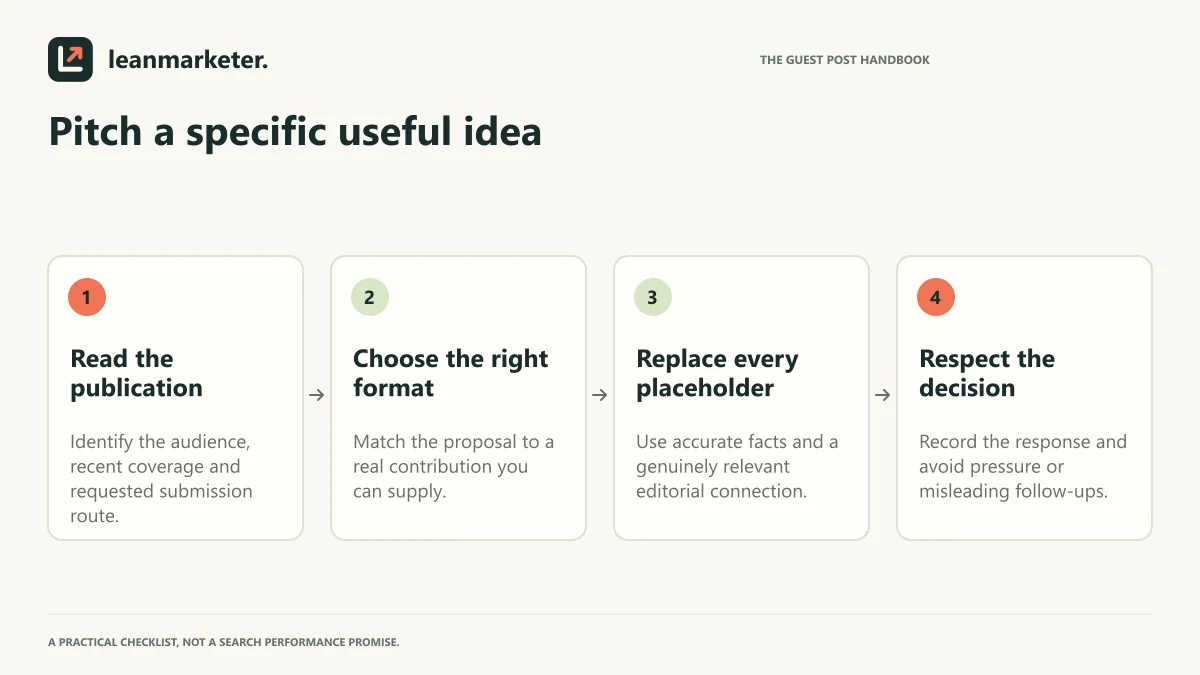
A pitch template should help organize a real idea, not create the appearance of research you have not done. The seven examples below cover different editorial contributions. Replace every bracketed field with accurate information, and discard any sentence that does not fit. None guarantees acceptance, replies or links. The editor’s decision depends on the publication’s needs and the quality of the proposal.
Before using a template, read the site’s contributor policy and recent work. Check whether it accepts external contributions, commercial arrangements or only particular formats. Mozilla Hacks’ public contributor information is one example of a publication explaining its audience and expectations. Every publication has its own process, so do not generalize one site’s requirements into a universal submission rule.
1. The practical how-to guide
Subject: Article idea: [specific reader task]
Hello [editor or team], I’m [name and accurate role]. Your recent coverage of [relevant subject] suggests an audience interested in [reader problem]. I can propose a practical guide to [specific task], covering [two or three concrete decisions]. It would include [original example or useful resource] rather than repeat a general introduction. Would this angle fit your current editorial plans? I can send a short outline if useful.
Use this when you can explain a task from relevant experience. Name the decision the guide helps readers make, rather than promising a broad “ultimate guide.” A useful outline shows what will be included and what is outside scope. Do not claim to have read an article unless you actually reviewed it.
2. The original-data proposal
Subject: Proposed analysis: [question your data addresses]
Hello [editor], our team has collected [accurate description of data] to investigate [question]. We can share the method, collection period and limitations, alongside [specific finding supported by the data]. I think a short analysis could help your readers evaluate [decision]. Would you consider the topic? Before drafting, I can provide a summary of the method and confirm which material can be published and attributed.
Only use this with data you have the right to publish. Explain limitations rather than selecting a striking number without context. A customer poll is not automatically representative of an entire industry. The pitch should invite scrutiny of the method, not use the word research to make a marketing claim sound independently established.
3. The specialist worked example
Subject: Worked example for [publication audience]
Hello [team], I work on [relevant activity] and would like to propose a worked example of [specific process]. The article would show [inputs], the decisions involved and where the approach may not apply. It would avoid confidential client details and unsupported performance claims. Your readers who handle [task] could use it to compare their own process. Is this a format you currently consider for external contributions?
The example can be illustrative if labeled honestly. Do not turn a hypothetical scenario into an unnamed customer success story. Show enough detail for the editor to understand the contribution, including what readers can learn without assuming that your result will generalize to every organization.
4. The missing-angle proposal
Subject: A follow-on angle for [existing topic]
Hello [editor], your article about [specific subject] explains [accurate summary]. A related question I can help address is [distinct question], especially for [reader group]. I propose a separate contribution covering [new angle] with [evidence or example]. This would complement the existing piece rather than rewrite it. Would the distinction be useful, or is that question already covered in your upcoming calendar?
This requires an actual gap, not a superficial title variation. Check the site’s archive before suggesting it. A reader asking a deeper question can justify another article; changing a few words in an existing heading cannot. Give the editor an easy way to tell you that the topic is already assigned.
5. The expert interview contribution
Subject: Interview proposal on [specific issue]
Hello [editor], I can arrange an interview with [person and verifiable role] about [question relevant to readers]. The discussion could cover [topics] and include [practical artifact or example] where publication rights allow. I would confirm the participant’s availability and your preferred review process before preparing a draft. Would an interview or a jointly developed question list be of interest to your publication?
Do not promise access to someone who has not agreed to participate. Clarify whether you are offering an interview, ghostwritten commentary or another format. The publication should understand who supplies the words, who checks factual statements and whether any commercial condition affects the proposed contribution.
6. The transparent commercial enquiry
Subject: Enquiry about [publication] contribution options
Hello [team], I’m contacting you on behalf of [organization]. We are exploring a relevant article about [topic] and would like to understand whether you offer commercial contribution options. Could you share your current policy, editorial requirements, disclosure approach and permitted references? We would review the publication fit and scope before preparing a draft. If this is outside your policy, please let me know and I will close the enquiry.
This is more honest than presenting a paid-placement request as an independent research contribution. Ask about the publication’s conditions before negotiating a specific anchor or destination. The editorial standards overview provides related questions about commercial treatment and the evidence a delivery report should contain.
7. The revised proposal after useful feedback
Subject: Revised angle following your feedback on [topic]
Hello [editor], thank you for explaining that [accurate feedback]. I have narrowed the idea to [new reader question] and would remove [material that did not fit]. The revised outline would cover [specific points] using [available evidence]. If the subject is still unsuitable, no problem; I will not continue revising it for this publication. Would you like to see the updated outline?
Use this only when the editor actually supplied feedback and further discussion is welcome. A clear refusal is not an invitation to keep finding new routes into the inbox. Record the response so another colleague does not restart the same conversation. Respecting the decision protects the relationship even when this proposal does not proceed.
Put the template inside a real process
Keep the publication, contact route, idea and response in a shared record. If the article is commissioned, turn the agreed angle into a proper brief with factual sources, scope and review responsibility. The brief and approval workflow illustrates that handoff. A pitch begins a conversation; it is not the finished specification for an article or a promise of publication.